When to Take Magnesium: Best Time, Forms, and Dosage
Consistency beats clock time, and food eases the gut effects. What actually matters for magnesium timing, forms, dosage, and spacing from other minerals.
Written by the Biostacks Team
Not medical advice. This content is for educational purposes only and is not a substitute for professional medical guidance. Always consult a qualified healthcare provider before starting, stopping, or combining any supplement or medication.
Search “best time to take magnesium” and you’ll find confident answers pointing at specific hours of the day. Most of that confidence is misplaced. For a mineral you’re topping up over weeks, the clock time you swallow the capsule matters far less than taking it at all, taking a form your gut absorbs, and not stacking it against the minerals it competes with. Here’s what the evidence actually supports.
Is there a best time of day?
For raising your magnesium status, no. Magnesium is stored and used across the whole body, and a single dose doesn’t get “wasted” because it landed at 9am instead of 9pm. What raises your level is the average intake over weeks, so the honest answer to timing is whichever time you’ll actually remember every day.
Two things do shift with timing, and both are about the dose experience rather than absorption. The first is the sedating effect. Magnesium acts on the nervous system in ways that many people find calming, which is why glycinate before bed is a common sleep routine. If you’re taking it partly for that reason, evening makes sense. If you’re not, the effect is mild enough to ignore. The second is the laxative effect at higher single doses, which is easier to tolerate spread across the day than dumped in one go.
That points to a practical rule that has nothing to do with the clock: if you’re taking more than about 200mg of elemental magnesium, splitting it into two smaller doses is gentler on the gut and tends to absorb slightly better than one large dose, because the saturable transport in the intestine handles smaller amounts more efficiently.
With or without food?
Either works, and food mostly helps with comfort rather than uptake. Taking magnesium with a meal slows the transit through your gut and tends to reduce the loose-stool effect that catches people out at higher doses. That’s the main reason to do it.
Form matters here more than the meal does. Poorly soluble forms like magnesium oxide lean on stomach acid to dissolve, so an empty stomach or a low-acid one blunts an already low absorption. Well-absorbed organic forms like glycinate and citrate are far less fussy about what you take them with. If a particular magnesium supplement upsets your stomach, moving it to a meal usually fixes it without changing the dose.
The forms, and what changes between them
The word “magnesium” on a label tells you very little on its own, because magnesium is always bound to another compound, and that compound decides how much your gut absorbs, how likely it is to loosen your stools, and where it tends to act.
Magnesium glycinate binds magnesium to the amino acid glycine. It absorbs well, sits gently in the gut, and glycine has calming properties of its own, which is why it’s the usual pick for sleep and general use. Magnesium citrate absorbs well too and is cheaper, with a stronger laxative pull at higher doses, which also makes it a common choice when constipation is the actual goal. Magnesium oxide is the cheapest and the most common on mass-market shelves, and its absorption is roughly 4 percent, so most of it passes straight through. That makes it a decent laxative and a poor way to raise your magnesium level. Magnesium L-threonate is the outlier: it crosses the blood-brain barrier more readily than the others and gets marketed for cognition, though the evidence there is earlier-stage and it costs more per dose.
For a fuller form-by-form breakdown, including malate and taurate, see our guide to magnesium forms.
How much per day
The recommended daily allowance is about 420mg for adult men and 320mg for adult women, counting all sources. Most people fall short from food alone, landing closer to 200 to 270mg a day, which is the gap a supplement is usually filling.
There’s a number that confuses people, and it’s worth explaining plainly. The tolerable upper intake level for magnesium from supplements is 350mg a day, which is lower than the RDA. That isn’t a contradiction. The 350mg ceiling applies only to magnesium from supplements and medications, not to magnesium from food and water, because the first sign of too much supplemental magnesium is diarrhoea rather than any deeper toxicity. Food-bound magnesium doesn’t produce that effect, so it isn’t capped the same way. The National Institutes of Health Office of Dietary Supplements sets and explains both figures.[1]
One more label trap sits underneath all of this. Supplement labels list the total weight of the compound, not the elemental magnesium inside it, so a 500mg magnesium glycinate capsule contains only around 50mg of actual magnesium. Reading the elemental figure is the only way to know what dose you’re really taking.
Spacing magnesium from other minerals
Magnesium shares intestinal transport pathways with other divalent minerals, so at high doses they compete for the same doorway into the bloodstream. The effect is modest and only shows up when the doses on both sides are large, but it’s real and easy to sidestep.
Calcium is the classic pairing, since calcium-magnesium formulas are sold everywhere. At typical supplemental amounts the competition is minor; at high doses each reduces the other’s uptake, and the fix is to separate them by a few hours rather than avoid one. Our article on magnesium and calcium covers where that line sits. The same logic applies to iron, which uses a transport protein that magnesium also passes through, so a high magnesium dose taken alongside an iron supplement can trim iron absorption a little. Details are in our piece on magnesium and iron. If you take any of these at higher doses, putting a meal or a few hours between them clears the overlap without touching your dose or form.
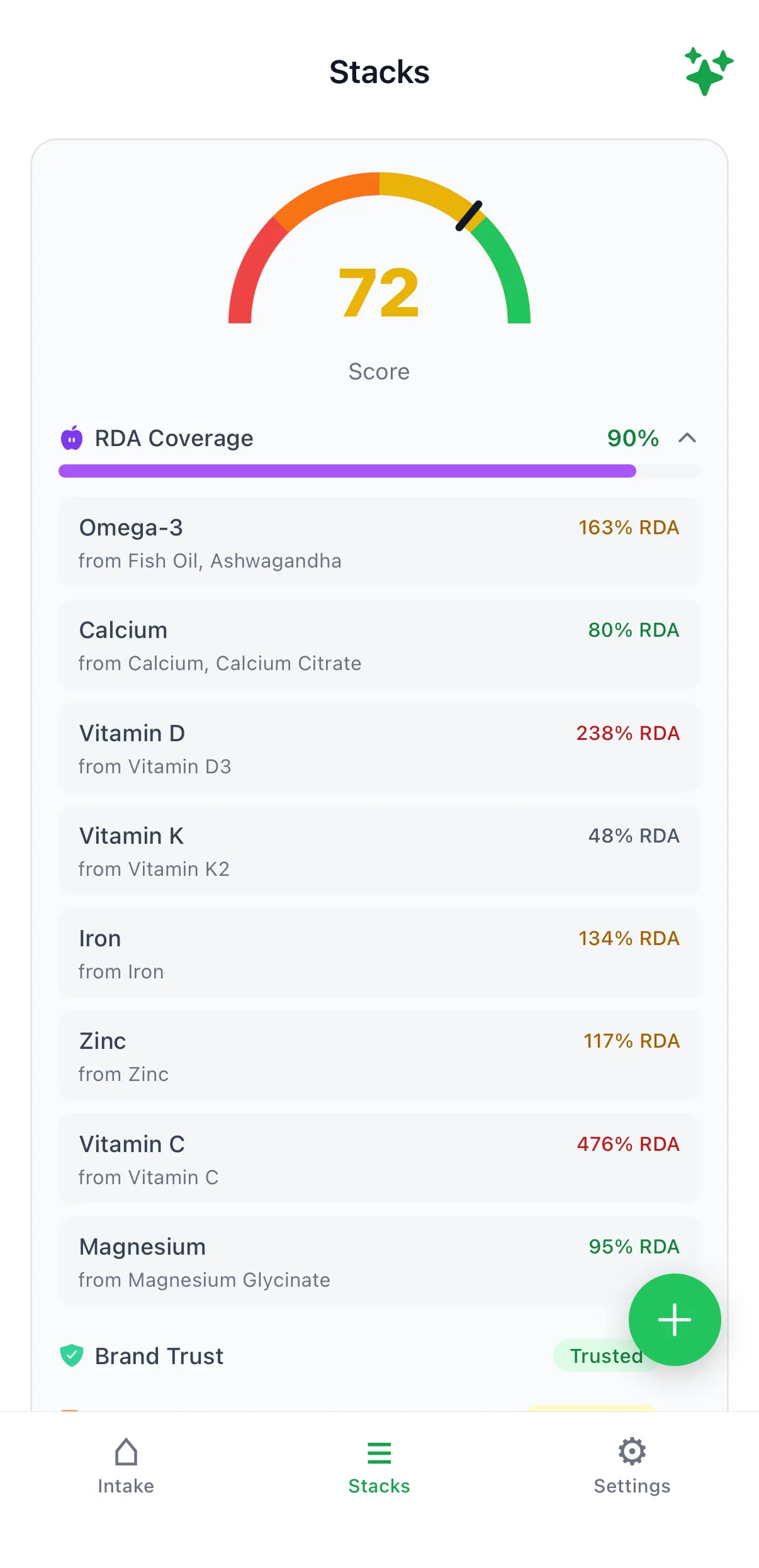
Biostacks tracks the specific form and elemental dose of the magnesium you’re taking, not just “magnesium” as a generic line item, and flags the calcium and iron overlaps automatically if you’re logging those too.
Reference
- National Institutes of Health, Office of Dietary Supplements. "Magnesium: Fact Sheet for Health Professionals." ods.od.nih.gov